

STREET MARKET IN RIO · PIX
A Pix payment at the street market. Two seconds, five contracts.
The shopper points her phone at the QR code and the vendor sees the payment come in. Behind that gesture, the app neither holds the account nor takes part in Pix, and the rules spell out who is allowed to do each thing.
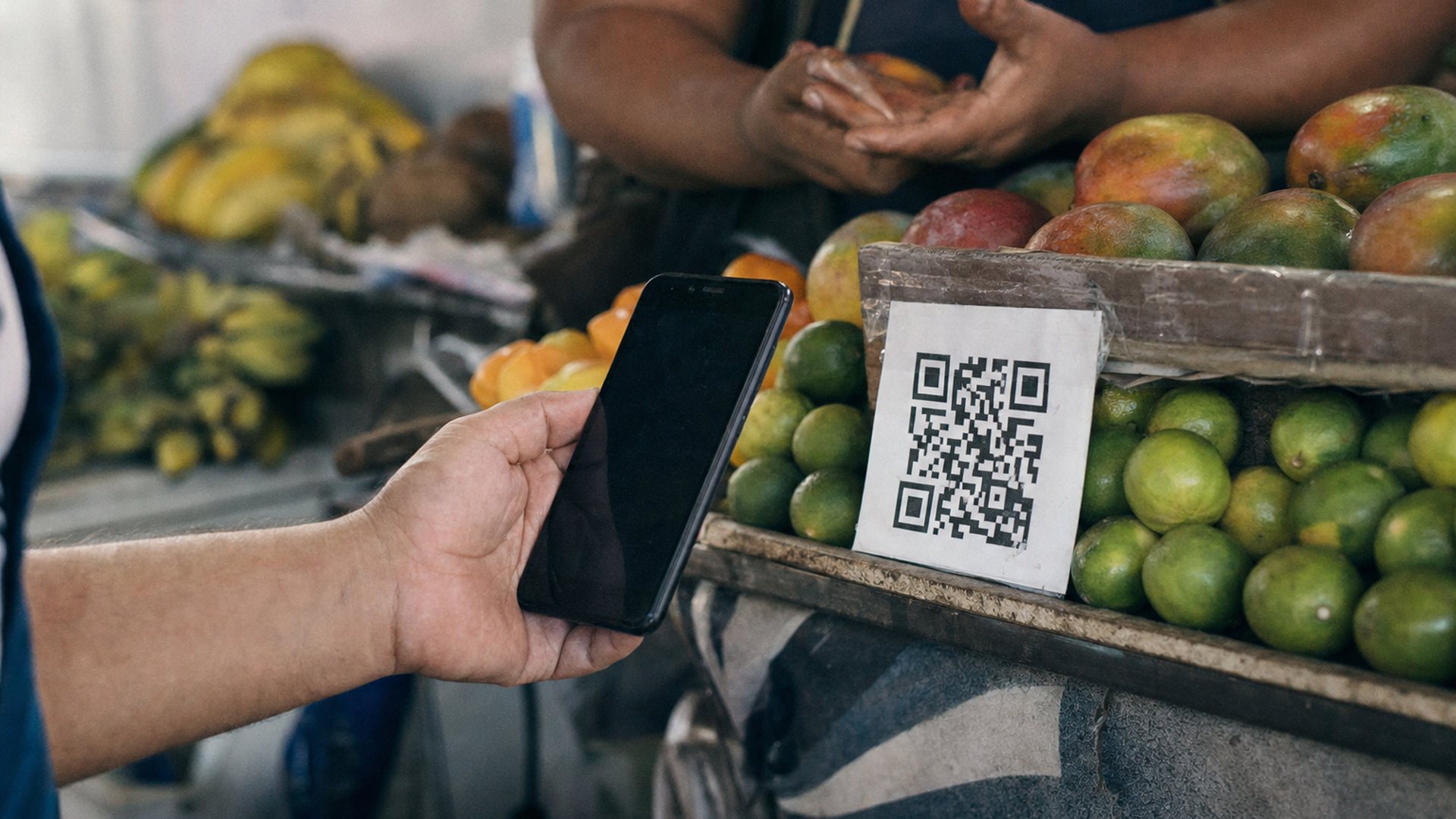
The app the shopper opens has its own brand, screens and customer support. The account that holds her balance, however, does not belong to the app. It belongs to a payment institution authorized by the Central Bank of Brazil (BCB), which provides the account and Pix, Brazil's instant payment system, through the app. Brazilian rules have a name for this model: banking as a service (BaaS), governed by Resolução Conjunta 16 (Joint Resolution 16 of the Central Bank of Brazil and the National Monetary Council), of November 2025.
Who does what
The path of a Pix payment made through the app
holds the authorizationmoneydata or instructioncontract
- 1The shopper scans the QR code and confirms the payment in the app. data
- 2The app passes the order to the institution that holds the account. data
- 3The shopper's account sits with the partner institution, not with the app. contract
- 4The institution adhered to the Pix Regulation and was approved by the Central Bank. contract
- 5The Pix leaves the shopper's account and settles in the SPI in real time. money
The vendor is paid at the institution of her choice. The app never receives or holds the money in an account of its own.
Five contracts hold the scene together:
- the shopper accepts the app's terms of use, which govern the experience and customer support;
- the shopper holds an account at the partner institution, which executes the Pix;
- the app and the partner institution sign the banking as a service agreement;
- the company behind the app is controlled by a holding company abroad, under its articles of association;
- the brand and the software reach the Brazilian operation under a license from another group company.
Why the account stays with the authorized institution
Lei 12.865/2013 (Brazilian Federal Law 12,865 of 2013), art. 6º, III, defines a payment institution as a legal entity that, by joining a payment scheme, engages in activities that include enabling deposits and withdrawals, executing payment instructions and managing payment accounts. Art. 9º, V, gives the Central Bank the power to authorize such institutions to operate. Resolução BCB 80/2021 (Central Bank of Brazil Resolution 80 of 2021), art. 9º, as amended by Resolução BCB 494/2025, requires the authorization to be granted before the institution starts providing the service, and the opening and maintenance of payment accounts follow Resolução BCB 96/2021.
Resolução Conjunta 16 sets out the division of labor. The account is held in the customer's name at the providing institution (art. 4º, § 2º). Customer identification, fraud prevention and anti-money laundering are the institution's responsibility, and it may use the app for ancillary tasks (art. 10, § 1º). The app discloses that it is not an authorized institution (art. 8º, § 2º, II) and does not receive customer funds into an account of its own (art. 8º, XIV). The institution does not contract a BaaS client company whose name uses terms characteristic of a financial or payment institution (art. 6º, VI). The institution's name stays visible on the screens and in the contracts (art. 14, I).
Where Pix comes in
Pix is the payment scheme established by Resolução BCB 1/2020, which approves the Pix Regulation. To take part, an institution adheres to the Regulation's rules, demonstrates technical and operational capacity (art. 24 of the Regulation) and obtains the Central Bank's approval of the adhesion process requirements (art. 25). Participation is mandatory for institutions with more than five hundred thousand active accounts and optional for other authorized institutions (Resolução BCB 1, art. 3º, caput and § 3º, I). Since January 1, 2025, only financial and payment institutions authorized by the Central Bank may apply to join (art. 3º, § 8º). Institutions offering transactional accounts must also meet a minimum share capital and net worth of R$ 5 million, required since January 1, 2026 (art. 3º-A).
The vendor holds her account at another institution. The Pix leaves the shopper's account at the partner institution and reaches the vendor's account over the scheme's rails, settling in the Central Bank's Instant Payment System (SPI). At no point does the app touch the money.
The app is the storefront. The account and the Pix belong to the authorized institution, which answers for them.
Paths without a license of one's own
There is more than one way to offer an account or Pix under the brand of a company that is not itself the authorized institution. Not all of them avoid a license, and one is no longer open to newcomers.
Four ways to put Pix into an app
In banking as a service, the app is the client company: the institution provides the service and answers for it. The contract follows the minimum content of art. 8º of Resolução Conjunta 16, and contracts already in place when it entered into force have until December 31, 2026 to comply (art. 22). The institution does not contract an app that already has a prepaid account banking as a service agreement with another provider (art. 6º, IV).
A payment initiation service provider holds a narrower license, not no license at all. Resolução BCB 80 defines it as the payment institution that initiates the transaction ordered by the customer without managing an account or holding the funds (art. 3º, IV, and § 2º), and it is subject to the same prior authorization requirement in art. 9º.
The contracting participant path existed for non-authorized payment institutions, which took part in Pix through a responsible participant. Art. 24, § 1º, of the Regulation, as amended by Resolução BCB 559/2026, still requires them to have a contract with that participant, which certifies and verifies requirements before the Central Bank (arts. 26 and 27). Resolução BCB 1, however, closed the door to new applications from 2025 onward (art. 3º, § 8º) and required those already under this regime to apply for authorization, with the last window running from January 1 to May 1, 2026 (art. 3º, § 9º, III). For anyone starting now, the path is one of the other three.
The part no one sees
The two contracts at the top of the diagram have nothing to do with payments. The holding company abroad controls the Brazilian company through its articles of association; the brand and the software are licensed by a group company in another country. Each piece follows the law of its own country, and the local corporate and tax treatment should be confirmed with local counsel. Payments between group companies in different currencies go through an institution authorized to operate in the foreign exchange (FX) market (Lei 14.286/2021 (Brazilian Federal Law 14,286 of 2021), art. 3º).
In principle, designing an operation like this starts with a map of roles: who serves the customer, who holds the account, who verifies the customer, who takes part in the scheme, and whether any amount passes through the app's own cash. Then come the choice of authorized institution and the contracts that reflect that division. When an operation follows a design like this, Strukta helps build the map of roles and coordinates the project with lawyers chosen and engaged directly by the client.
Sources Lei 12.865/2013, arts. 6º, III, and 9º, V; Res. BCB 80/2021, arts. 3º, IV and § 2º, and 9º (as amended by Res. BCB 494/2025); Res. BCB 96/2021; Res. Conjunta 16/2025, arts. 4º, § 2º, 6º, IV and VI, 8º, XIV and § 2º, II, 10, § 1º, 14, I, and 22; Res. BCB 1/2020, art. 3º, caput, §§ 3º, 8º and 9º, and art. 3º-A; Regulamento do Pix (annex to Res. BCB 1/2020), arts. 24, 25, 26 and 27; Lei 14.286/2021, art. 3º. Fictional entities; analysis in principle.
Informational content, in principle only. Not legal advice or an investment recommendation. Each transaction has its own classification, which depends on review by a lawyer chosen and engaged directly by the client.