

LISBON · CARD
A coffee in Lisbon, three countries in one tap.
A Brazilian customer taps a card on the terminal of a Lisbon pastry shop. Within seconds, an issuer in Brazil, a card network and an acquirer in Portugal approve the purchase, and the currency exchange stays with whoever is authorized to carry it out.
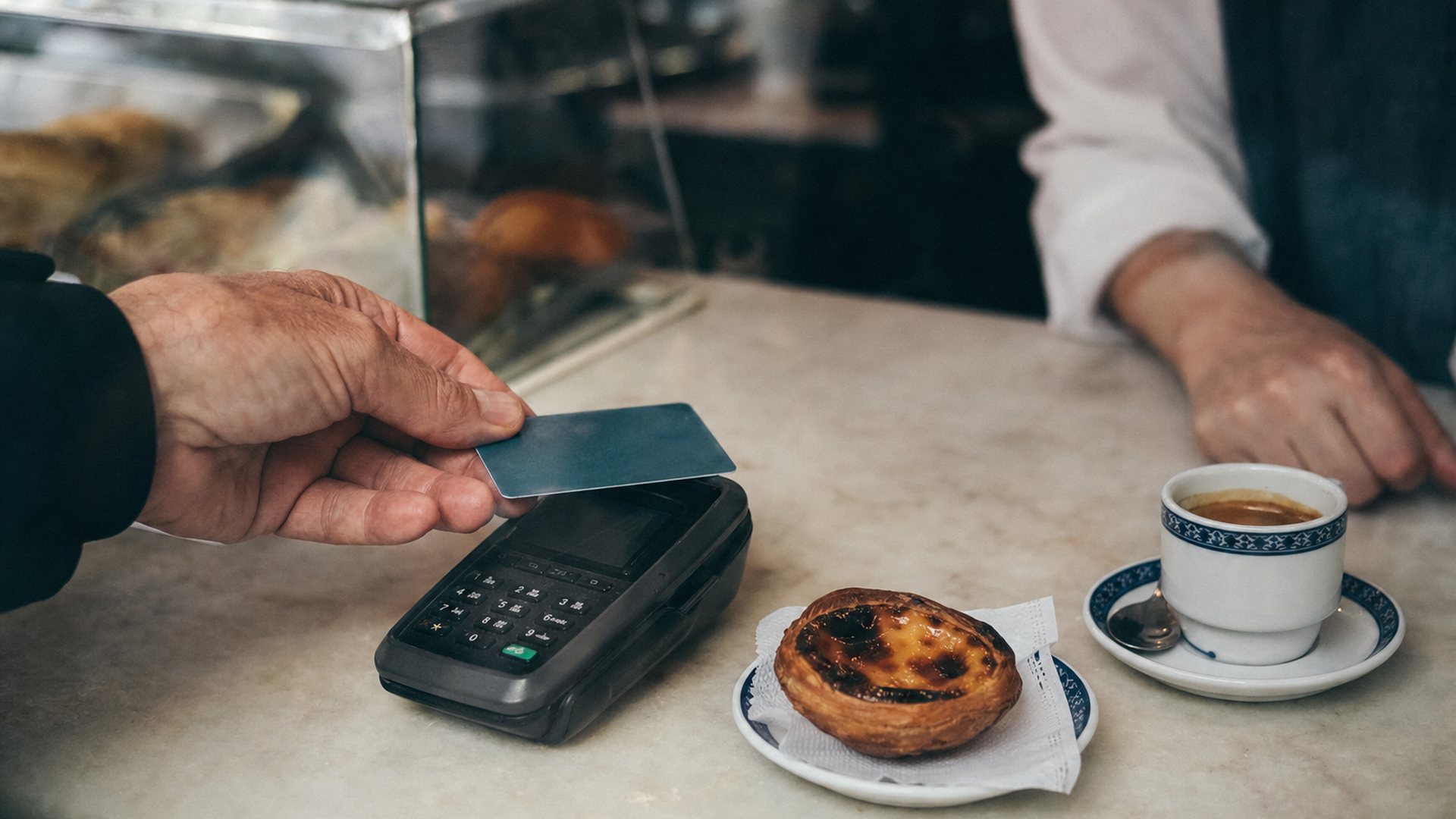
The coffee costs a few euros and the payment looks simple. Behind it there is a payment scheme, a chain of contracts and a foreign exchange (FX) transaction, and each piece has a party responsible for it under the rules.
Four roles and who fills them
- the customer has a card agreement with the issuer, in Brazil, that provides for international use;
- the issuer joins the card network's payment scheme and issues the payment instrument;
- the acquirer, in Portugal, takes part in the same scheme and enables the pastry shop to accept the card;
- the pastry shop has a merchant acceptance agreement with the acquirer and is paid through it.
The issuer and the acquirer do not need to sign a contract with each other. What connects them is the scheme's rulebook, which defines how the purchase is authorized, how settlement happens and how the acquirer is paid in order to pass the funds on to the merchant.
What Brazilian rules require of each role
Lei 12.865, of 2013 (Brazilian Federal Law 12,865 of 2013), names the roles in article 6. A payment scheme is the set of rules and procedures governing a payment service accepted by more than one payee (item I). The scheme owner is the legal entity responsible for the scheme and, where applicable, for the use of the brand associated with it (item II): this is the card network's role. A payment institution is an entity that, by joining one or more schemes, issues payment instruments or acquires their acceptance, among other activities (item III, subitems "d" and "e"). Banks also join schemes, as provided in § 1º of the same article.
Resolução BCB 150 (Central Bank of Brazil Resolution 150) regulates the schemes that form part of the Brazilian Payment System. Article 3 requires the scheme owner to be incorporated in Brazil, with technical, operational and financial capacity, governance and risk management. Article 10, item II, defines as cross-border a scheme whose instrument is issued in Brazil for use in other countries, which is the case of the customer's card. Resolução BCB 80, in article 3, describes the institution types: the issuer of a postpaid instrument manages the payer's account (item II); the acquirer onboards payees and takes part in settlement as a creditor of the issuer (item III).
Where foreign exchange comes in
The purchase is in euros and the card statement is in reais. That is foreign exchange, and Lei 14.286, of 2021 (Brazilian Federal Law 14,286 of 2021), states in article 3 that transactions in the FX market may only be carried out by institutions authorized by the Central Bank of Brazil (BCB). Resolução BCB 277 treats international card use as eFX (cross-border payment service), the international payment or transfer service that enables in-person purchases of goods and services abroad (article 49, item I, subitem "a"). As amended by Resolução BCB 561, in force since October 1, 2026, § 2º of article 49 lists who may provide eFX: banks, Caixa Econômica Federal, development agencies, credit, financing and investment companies, securities brokers and dealers, FX brokers, and payment institutions acting as electronic money issuers, postpaid instrument issuers or acquirers.
Three requirements apply to the issuer. Payment between the eFX provider and its counterparty abroad goes through an FX transaction or a non-resident account in reais, and the use of virtual assets is prohibited (article 50, same wording). For each purchase abroad with an internationally enabled card, the statement itemizes the amount in dollars, the conversion rate and the final amount in reais (article 52, sole paragraph, item II). And the issuer of a card issued in Brazil reports these transactions to the Central Bank through the Sistema Câmbio, the Central Bank's FX reporting system (article 81-A, item I).
Who does what when a Brazilian card pays for coffee
holds the authorizationmoneydata or instructioncontract
- 1The customer pays the bill in reais to the issuer, under the international use agreement. money
- 2The authorization request runs over the card network, under the scheme's rulebook. data
- 3Under the scheme's rules, the amount reaches the acquirer; the reais leg is FX. money
- 4The acquirer pays the pastry shop in euros, under the acceptance agreement. money
Portuguese side: the acquirer's status and the merchant agreement should be confirmed with local counsel.
The customer sees a tap. The card network connects the ends, the authorized issuer answers for the FX and the Portuguese acquirer answers for acceptance.
The Portuguese side
In Portugal, the acquirer enables the merchant to accept the card and receives the sale proceeds in order to pass them on. The pastry shop signs the merchant acceptance agreement with it. The acquirer's authorization, the supervision it is subject to and the law governing the merchant agreement follow Portuguese law and the applicable European rules, and that treatment should be confirmed with local counsel.
Paths without a license of one's own
A company that wants to put a card bearing its brand in the hands of Brazilian customers does not need to take on the issuer's role. The regulated service stays with an authorized institution, and the company comes in through one of these doors, each with its own condition.
Four ways to put a card in a customer's hand
Two rules run across these paths. Resolução Conjunta 16 (Joint Resolution 16 of the Central Bank of Brazil and the National Monetary Council), which governs banking as a service (BaaS), sets a closed scope in article 4: deposit and payment accounts, payment services made through them, acquiring and credit. The customer's account stays at the providing institution (§ 2º), and the FX for international use remains a service of the issuer, as eFX provider. Resolução Conjunta 17 (Joint Resolution 17), in article 8, prohibits the authorized institution from contracting a correspondent or partner that uses in its name a term typical of an authorized institution and does not make its status as contractor or partner clear to the public. The brand may belong to the company; the party providing the service has to be visible, as article 14 of Resolução Conjunta 16 also requires.
In principle, the design starts with a map of roles in each country: who issues, who handles the FX, who acquires and who faces the customer. Then come the choice of authorized institution and point of entry, and the list of what each contract needs to reflect. When an operation follows a design like this, Strukta helps build the map of roles and coordinates the project with lawyers chosen and engaged directly by the client in each jurisdiction.
Sources Lei 12.865/2013, art. 6º, I, II and III, "d" and "e", and § 1º, and art. 10, § 2º; Res. BCB 150/2021, arts. 3º and 10, II; Res. BCB 80/2021, art. 3º, II and III; Lei 14.286/2021, art. 3º; Res. BCB 277/2022, art. 49, I, "a", and §§ 2º and 3º, and art. 50 (as amended by Res. BCB 561/2026), art. 52, sole paragraph, II, and art. 81-A, I (as amended by Res. BCB 561/2026); Res. Conjunta 16/2023, arts. 3º, 4º and 14; Res. CMN 4.935/2021, arts. 3º and 12; Res. Conjunta 17, art. 8º. Portugal: local treatment to be confirmed with local counsel. Fictional entities; analysis in principle.
Informational content, in principle only. Not legal advice or an investment recommendation. Each transaction has its own classification, which depends on review by a lawyer chosen and engaged directly by the client.